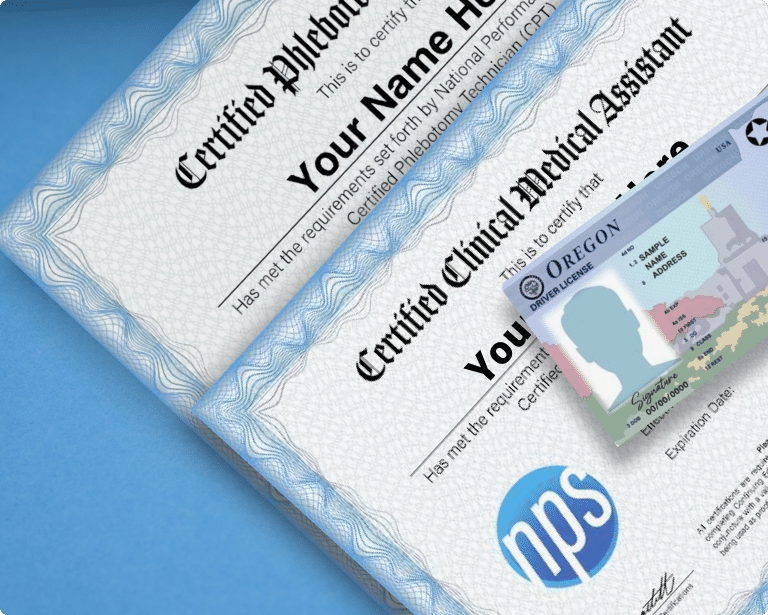
– Understanding who issues a credential and what it establishes can prevent confusion about training, certification, and legal authorization. –
By Brandon Oxendine, President, National Performance Specialists
One of the easiest ways to make a career decision harder than it needs to be is to treat every credential as if it means the same thing.
A certificate of completion, a professional certification, and a state license may all appear on a resume. They may all matter to an employer. In some cases, a person may need more than one of them.
But they come from different systems and answer different questions.
For allied health candidates, that distinction matters before you choose a training program, register for a certification exam, apply for a job, or try to understand what your state requires.
The simplest place to start is this: who issued the credential, and what does it actually establish?
What is a certificate of completion?
A certificate of completion is generally connected to education or training.
A school, college, training provider, employer, or other educational organization may issue one after a learner completes a course or program. The certificate shows that the person completed that learning experience.
That is different from professional certification.
The U.S. Bureau of Labor Statistics distinguishes a postsecondary certificate from certification issued by a professional organization or certifying body. The Institute for Credentialing Excellence makes a similar distinction: certificate programs are centered on education or training, while professional certification evaluates knowledge, skills, or competencies against established requirements.
Some certificate programs include an assessment at the end. That does not automatically make the credential a professional certification. The key question is still what the program was designed to do.
If its main purpose is to teach a defined body of material and recognize completion or mastery of that specific learning experience, it is a certificate program.
What is professional certification?
Professional certification is a credential awarded by a nongovernmental certification body.
It normally requires a candidate to meet eligibility requirements and successfully complete an examination or other assessment process. Depending on the certification, eligibility may involve education, training, work experience, documented procedures, or other requirements.
Professional certification is not the same thing as the training that may help someone become eligible for it.
That separation is important.
A training provider teaches. A certification organization evaluates candidates against the requirements of the certification program and issues the credential when those requirements are met.
The Bureau of Labor Statistics describes certification as a credential awarded by a nongovernmental certification body after an individual demonstrates designated knowledge, skills, or abilities through an examination process. Certification itself does not grant legal authority to work in an occupation.
That last point is where certification and licensure are most often confused.
What is a license?
A professional license is issued by a government licensing authority.
Licensure can give a person the legal authority to work in a regulated occupation or perform duties that the law reserves for licensed individuals.
Licensing requirements are not the same everywhere. States may set different education, examination, experience, renewal, or other requirements for the same occupation.
That means a national certification should never be assumed to replace a state license.
It also means candidates should be cautious with broad statements such as “this credential lets you work anywhere.” Whether a license or other state authorization is required depends on the occupation, the state, and sometimes the specific duties being performed.
Certificate vs. certification vs. license: the practical difference
For candidates, the distinction can be reduced to three questions.
Did I complete education or training?
A certificate of completion may document that learning experience.
Did I meet the requirements of an independent certification program?
A professional certification may document that you met eligibility requirements and successfully completed the certification assessment.
Has a government authority given me legal permission to practice a regulated occupation or perform regulated work?
That is the role of licensure.
These credentials can complement one another, but they are not interchangeable.
A person might complete a training program, earn a professional certification afterward, and still need a state license or other authorization before performing certain duties. Another occupation may not require a state license at all.
How do I know what I actually need?
Before paying for a program or registering for an exam, check the requirements from the organizations that actually control each part of the process.
- What does the employer require?
Employers may have their own credential, experience, onboarding, or competency requirements. - Does my state regulate this occupation or specific duties?
State requirements can differ. Check the appropriate state licensing or regulatory authority when applicable. - What are the certification eligibility requirements?
Review the current requirements from the certification provider before registering for an examination. - What did my training program actually award?
Confirm whether you earned a certificate of completion, an assessment-based certificate, a degree, or another educational credential.
Those questions are more useful than relying on a credential name alone.
Where NPS fits
National Performance Specialists is a national certification and examination provider.
NPS provides certification eligibility review, national certification examinations, credential issuance, renewal, and verification for NPS-issued credentials. NPS does not replace the school or training provider that teaches the candidate, the employer that evaluates workplace performance, or the state authority that determines whether licensure or other legal authorization is required.
Candidates considering an NPS certification should review the current eligibility requirements for the certification they plan to pursue. The NPS Candidate Handbook provides the governing program requirements and certification policies.
The larger lesson is simple: a credential is most useful when you understand what it represents, who issued it, and what it does not replace.
If you are ready to pursue an NPS certification, review the available certification options and choose the program that matches your role and eligibility.
Important candidate notice
NPS certification does not guarantee employment, interviews, job placement, wages, employer acceptance, hiring timelines, state licensure, scope-of-practice authorization, or hands-on completion. Candidates are responsible for confirming applicable state, employer, and facility requirements.